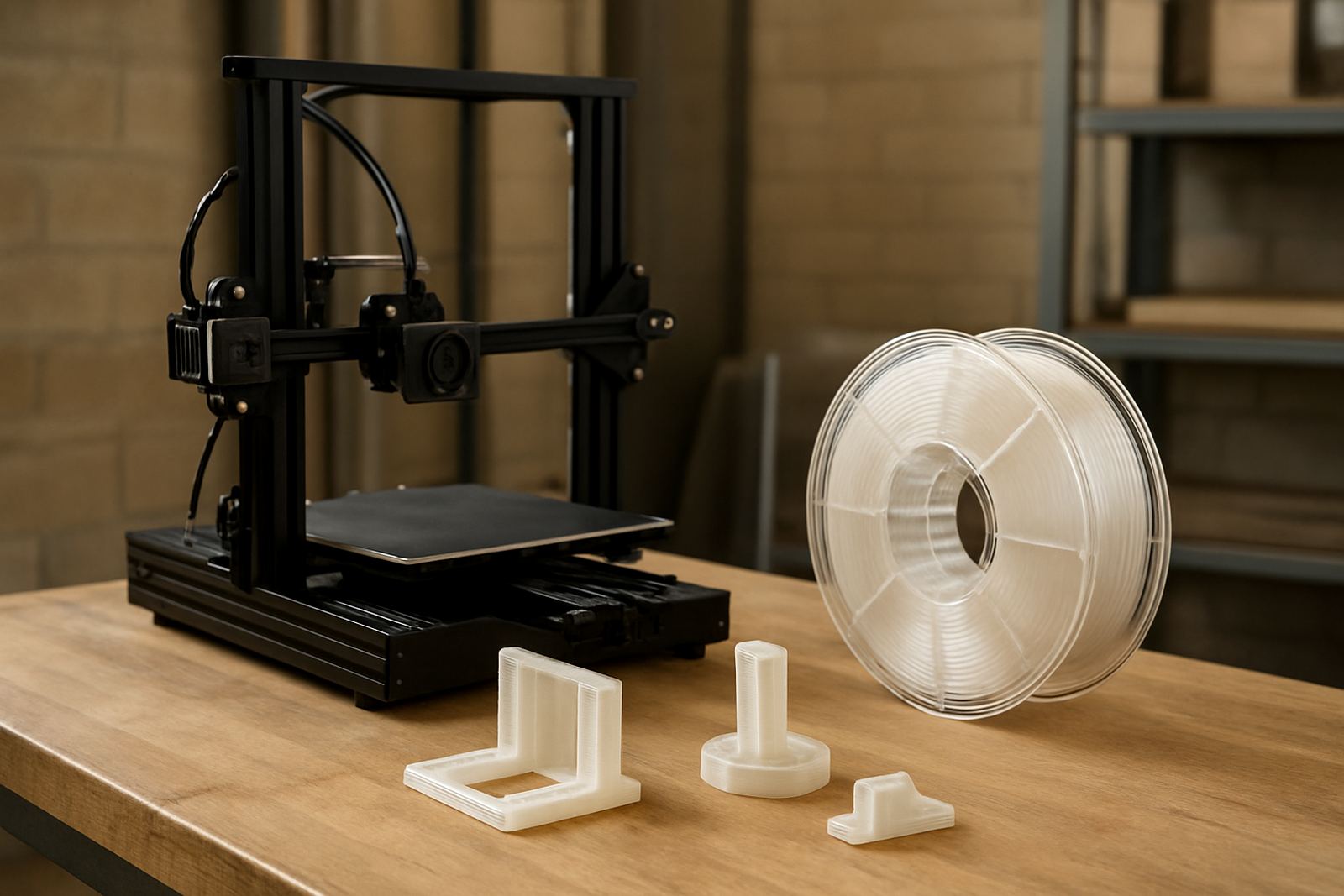
What clear PETG filament is used for
Clear PETG is a thermoplastic filament for fused filament fabrication printers when you need a transparent or translucent result. It prints with more toughness than many brittle clear plastics, so it is a sensible option for parts that must handle handling, mild knocks and everyday use. In South Africa it is often ordered for prototype covers, light diffusers, inspection windows, jigs, sign elements and model parts where a clean see-through look is useful.
Because PETG has a balanced mix of strength and flexibility, it is easier to live with than highly rigid clear materials that crack if stressed. It is also useful for short production runs where a part must look tidy and still do a proper job. Clear prints will never be perfectly glass-like straight off the printer, but with the right settings you can get a very acceptable translucent finish.
Sizes, spool options and what we supply
Clear PETG filament is supplied in the standard 1.75 mm diameter for most benchtop and workshop printers. Typical spool sizes are 1 kg, and larger quantities can be arranged for regular users, production teams or training rooms that print often. If you need consistent supply for a batch job or repeat prototyping, it helps to order enough material for the full run so colour and finish stay matched.
For order planning, the points below matter most:
- Filament diameter: 1.75 mm
- Common spool mass: 1 kg
- Finish: clear, translucent or lightly tinted depending on print settings
- Use: prototyping, functional parts, display items and covers
- Supply: couriered nationwide from Cape Town
- Collection: available in Epping, with nearby collection areas by arrangement
When you are comparing options, ask whether the print needs maximum transparency or simply a neat light pass-through effect. That choice changes the infill, wall count and surface finish you should use.
Where clear PETG suits best
This material is a good fit for manufacturing support, product development, design studios and home users who want a tougher clear print. It works well for covers, guards, lenses for non-critical applications, fluid view sections, cable covers, test housings and presentation models. In Cape Town and surrounds it is often used where the final part must look clean enough for client review, but still be strong enough for fitment testing.
Clear PETG is not the best choice for every job. If the part must be perfectly optically clear, or it will sit in direct sun for long periods, another material or a different construction method may be better. For most practical applications though, it gives a good balance of clarity, durability and printability.
- Good for display parts and transparent covers
- Suitable for jigs, guides and housings
- Useful for light-diffusing panels and inspection pieces
- Better than brittle clear plastics where some flex is needed
Printer setup, power needs and clean results
Clear PETG prints on many standard FDM printers, so no special gas supply or external power source is needed beyond your normal printer setup. A stable bed, a clean nozzle and steady extrusion are more important than anything complicated. If your workshop in Epping, Bellville or Somerset West is affected by load-shedding, it is worth using a proper backup plan so the print does not stop mid-layer and leave a visible line or weak section.
For practical printing, keep an eye on temperature control, bed adhesion and moisture. PETG is more forgiving than some clear materials, but it still needs a sensible setup. Use a printer enclosure only if your machine benefits from it, and make sure there is enough ventilation around the equipment. If the room is damp, the filament should be stored in a sealed bag or container because absorbed moisture can cause bubbling, stringing and cloudy sections.
Recommended printer settings vary by machine, but a useful starting point is:
- Nozzle temperature: 230 C to 250 C
- Bed temperature: 70 C to 85 C
- Print speed: moderate, usually 30 to 60 mm/s
- Cooling: low to medium, depending on part size
- Layer height: 0.12 mm to 0.28 mm for different finish needs
Care, storage and servicing between print runs
Clear PETG needs straightforward care. Keep the spool dry, wipe dust off the filament path and check that the drive gears are not chewing into the line. If you print regularly, it helps to inspect the first metre of filament before loading because a nick or kink can cause feeding issues later in the job. Coastal humidity in Cape Town can affect storage, so sealed containers with desiccant are a practical choice, especially if the spool will sit for a while between jobs.
Printer servicing matters too. A partly blocked nozzle can show up as cloudy flow, poor layer bonding or uneven lines in the final part. Clean the nozzle when needed, level the bed properly and replace worn PTFE tubing or drive parts before they start causing trouble. If a print must look neat on the outside, plan a test piece first so you can confirm flow and surface finish before committing to the full run.
What to check before you order
Before placing an order, check the filament diameter your printer accepts, the spool size you need and whether the part must be fully clear or only translucent. If you are printing in batches, confirm the quantity required and whether the same batch must be used throughout. For production work, consistency in wall thickness, infill and print orientation has a big effect on the final look of clear PETG.
The points below are worth confirming before checkout:
- Printer accepts 1.75 mm filament
- Job needs clear, translucent or lightly tinted finish
- Enough stock is ordered for the full batch
- Storage will be dry after delivery
- Printing temperatures suit your machine
- Any post-processing, sanding or polishing plan is understood
If you are ordering for a client job, include the expected finish, quantity and deadline in the enquiry form so the right advice can be given from the start. That saves time later and helps avoid waste.
Ordering in Cape Town and getting it delivered nationwide
Clear PETG filament is available from our Cape Town base in Epping, with courier delivery across South Africa. Clients also make use of nearby collection areas including Montague Gardens, Bellville, Parow, Somerset West, Paarl, Stellenbosch and Claremont. If you need material cut, packed or labelled for a workshop schedule, the enquiry form on the contact page is the place to start.
For customers who run repeated prints or small production work, it helps to keep a note of the settings that gave the best result. PETG can reward careful setup, and once your process is tuned the prints are consistent and useful. If you need material advice before ordering, send the details of the printer, part size and intended use so the right option can be suggested.
Key facts
| Material | PETG filament for 3D printing |
|---|---|
| Filament diameter | 1.75 mm |
| Spool size | 1 kg standard |
| Finish | Clear to translucent |
| Recommended nozzle temperature | 230 C to 250 C |
| Recommended bed temperature | 70 C to 85 C |