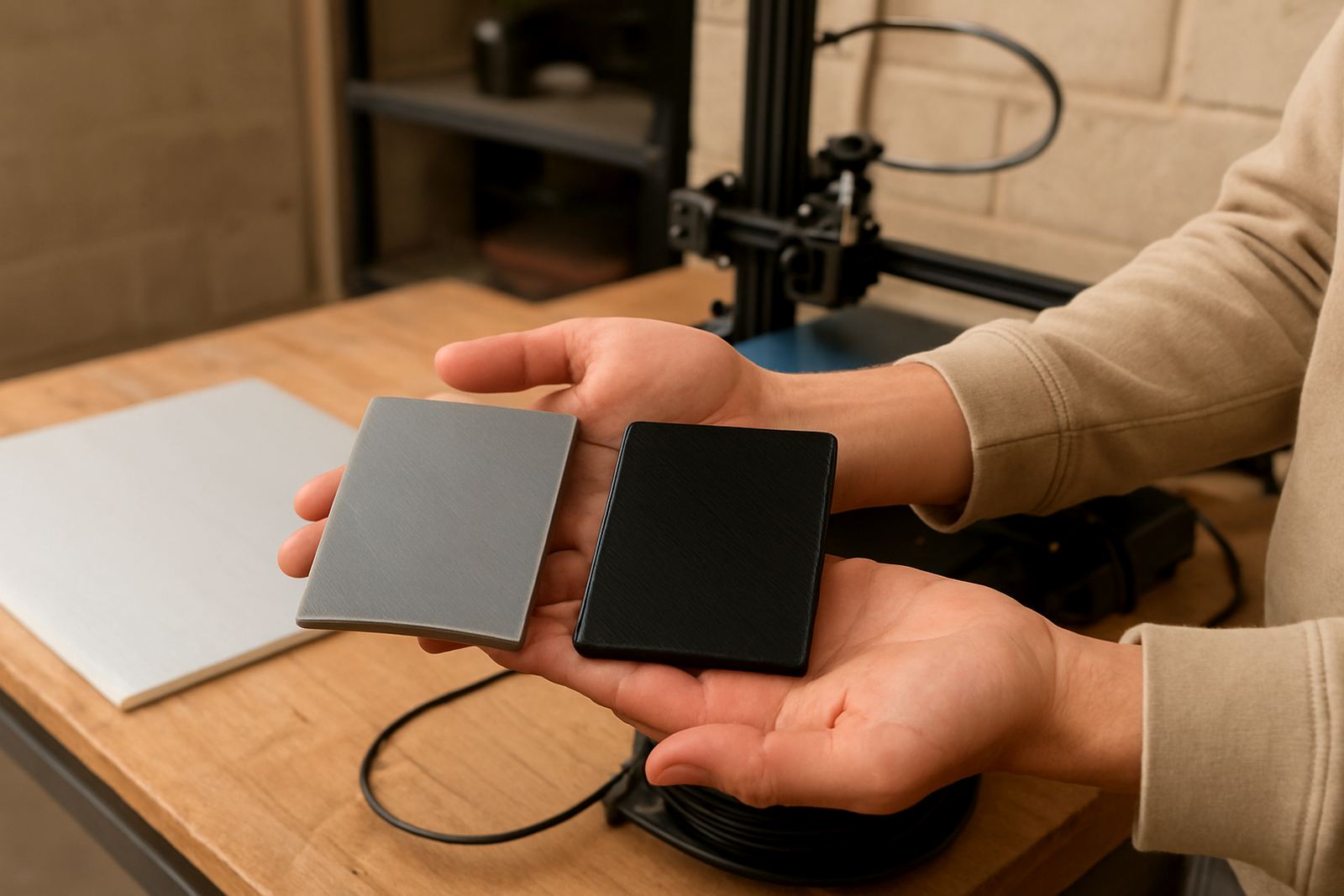
Why this choice matters before the first layer goes down
Many print jobs fail not because the design is wrong, but because the material was matched badly to the real conditions. A bracket for a workshop in Epping, a cover for a retail fitting in Somerset West, or a prototype that must survive a hot bakkie cab all ask different things from the plastic. PETG and ABS both get used for functional parts, yet they are not interchangeable.
PETG is generally easier to print, with less warping and less smell than ABS. ABS can handle more heat in some uses, but it is fussier and more likely to lift off the bed if the setup is not right. That matters when load-shedding interrupts a long print or when a coastal workshop in Muizenberg is dealing with humidity and temperature swings, because the process needs a bit more stability than people expect.
PETG gives you easier printing and a cleaner day-to-day process
For many South African users, PETG is the practical middle ground. It prints with less drama, bonds well between layers and usually keeps its shape better than PLA in a working environment. It also offers good impact resistance, so it suits brackets, guards, clips, trays and housings where a part may get knocked around.
- Less warping than ABS on most benchtop machines
- Good chemical resistance for many workshop and light industrial uses
- Better layer adhesion for parts that must flex a little
- Lower odour during printing, which helps in shared spaces
For prototyping, PETG often saves time because you spend less effort fighting the printer. That is useful when a design team in Bellville needs three revisions in a week and cannot lose a day to curled corners or cracked edges.
Where ABS still makes sense for tougher heat exposure
ABS is still used when higher temperature resistance is important and the print setup can support it. If a part sits near a motor, inside a warm enclosure or in a location that gets proper summer heat, ABS may be the better fit, provided the printer can hold a stable chamber and the operator is comfortable working with it.
It is worth saying plainly that ABS can be less forgiving. It tends to warp more, can split if cooling is uneven and often needs more finishing work after printing. If you need a smooth final surface for sanding, drilling or painting, ABS can be useful, but only if you allow for the extra labour. In small batches, that extra time can be fine. In a fast turnaround job, it may not be.
- Choose ABS when heat resistance is a priority
- Choose ABS when post-processing is part of the job anyway
- Use a controlled print environment to reduce warping
For sheets, PETG often gives the better workshop result
PETG is not only about filament. As a sheet material, it is often chosen for guards, covers, display pieces, machine shields and small fabricated components. It cuts cleanly, can be supplied to size and suits a range of workshop uses where clarity or impact resistance matters. In Cape Town, that can be handy for fabrication shops working to municipal requirements around safe guarding and equipment protection, especially when a job needs a neat edge and accurate dimensions.
Compared with ABS sheet, PETG sheet is usually easier to handle for cutting and forming without so much cracking at the edge. That makes it a sensible option for smaller manufacturing jobs, custom panels and short-run parts. If you need strips, panels, hole marking or edge deburring, it helps to start with a material that behaves predictably under the blade and the drill bit.
A local example from a Cape Town production floor
Picture a small manufacturer in Epping making protective covers for a packing line. The part needs to fit a frame, survive constant handling and hold up in a space where heat builds up during the day. The team could use ABS, but the print risk is higher and the lead time grows if the part warps or splits. PETG may be the better call if the job is about dependable function rather than extreme heat exposure.
Now change the setting to a prototype that must sit near warm electronics in a sealed enclosure. That is where ABS starts to earn its place. The key is to test the actual use case, not just the material name. A print that looks fine on the machine and fails in a factory is still a failure, no matter how good the first sample looked.
- Use PETG for guards, clips, brackets and general-use prototypes
- Use ABS where sustained heat is more of a concern
- Check the part in the real environment before full production
How to choose the safer option for your job
If you are deciding between PETG and ABS, start with three questions. How hot will the part get? How much impact or flex will it take? How much finishing time do you have? The answers usually point you in the right direction. PETG suits a lot of everyday South African print work because it is stable, practical and less demanding on the machine. ABS is a useful specialist material when the extra print control is worth it.
For customers collecting from Epping, Montague Gardens, Bellville, Parow, Somerset West, Paarl, Stellenbosch or Claremont, the best approach is often to ask for material advice before the job starts. That helps with cut-to-size sheet work, batch cutting, courier packing and labelling where needed. It also reduces waste, which matters when you are running on a budget and cant afford to remake a part just because the material choice was off.
If your next project needs a straight answer, PETG is often the first material to consider and ABS the backup when heat is the deciding factor.