
Start With Dry Material and a Clean Feed Path
Layer adhesion starts before the nozzle heats up. PETG absorbs moisture if it sits open in a workshop, and in Cape Town that can happen quicker than many people expect, especially near the coast or in a busy space with doors opening all day. Damp filament tends to pop, string and leave a rough surface, which weakens the bond between layers. If the material has been stored in a warm storeroom, keep it sealed with desiccant and dry it before a long run.
Check that the filament path is smooth from spool to extruder. A tight bend, a rough guide tube or dirty drive gear can cause small underfeeds and those gaps show up as weak lines inside the part. For teams in Epping, Montague Gardens or Bellville Collection areas, it is worth treating filament storage like any other stock item: labelled, dry and off the floor.
- Store unopened filament in a sealed bag or tub
- Dry damp filament before printing long jobs
- Keep the feed path free of dust and offcuts
- Use job labels so the right reel goes with the right settings
Use Heat and Cooling That Suit PETG, Not PLA Habits
One common mistake is to print PETG like a cooler, faster material. PETG usually likes a warmer nozzle and a stable bed so each fresh line stays soft enough to knit into the one below it. If the nozzle temperature is too low, the layers sit on top of each other rather than fusing. Too much fan can also cool the surface too quickly, which is useful for sharp detail but bad for strength.
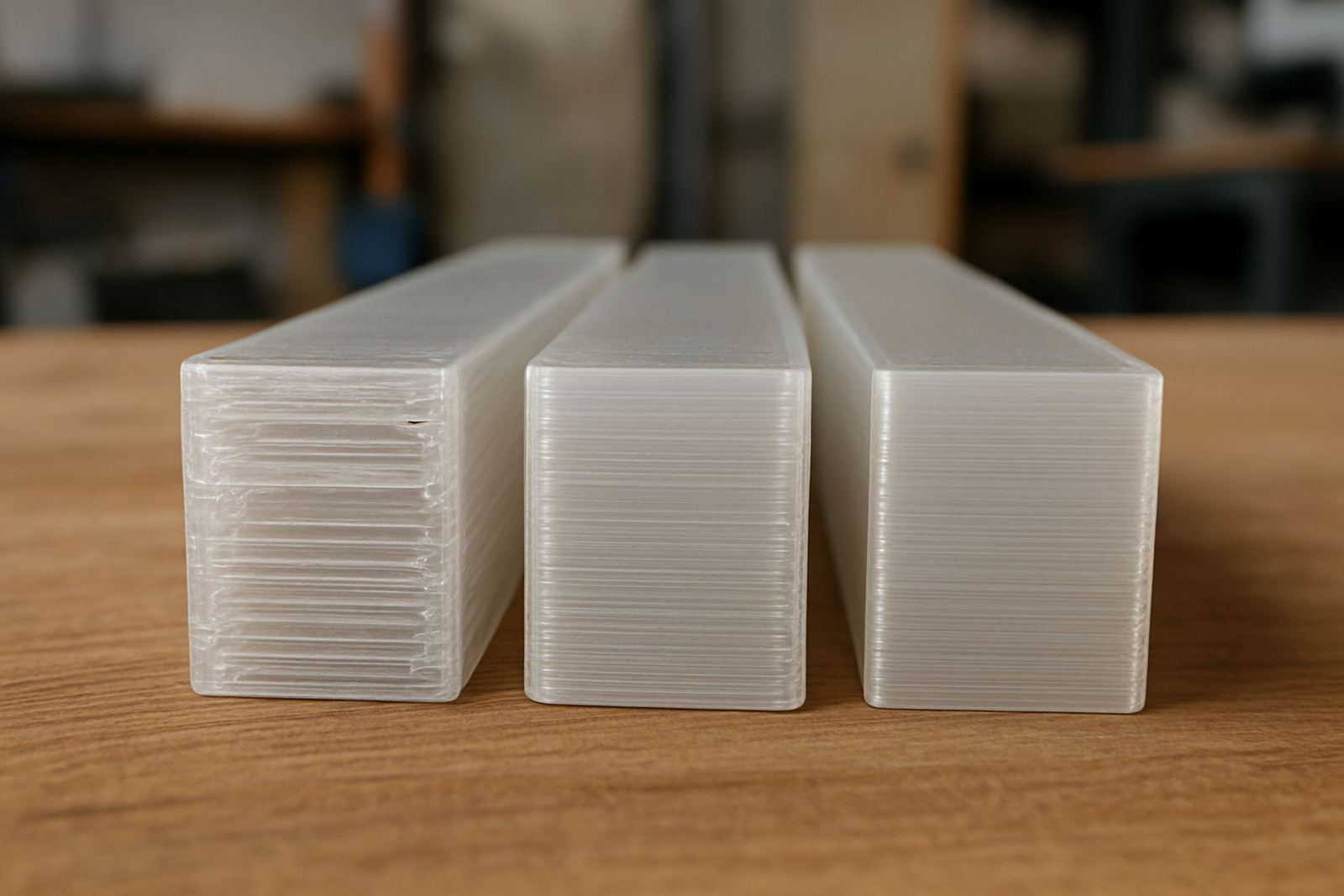
There is no single setting that works for every printer, yet a sensible starting point helps. Run test strips and watch how the layers look when the part bends. If the surface looks neat but splits along the layer line, the issue is often heat, not infill. In a warehouse in Somerset West, a part used for a bracket on a conveyor may need a slower print with less cooling, while a display piece for a design studio in Claremont may accept a little more fan for cleaner edges.
- Increase nozzle temperature in small steps
- Keep bed heat steady for the full print
- Reduce part cooling where strength matters most
- Print a test coupon before a full batch
Printing Slower Can Improve the Bond Between Layers
Strength between layers often improves when the printer is not rushing. A slower speed gives the hot filament more time to press into the layer below it. It also gives the extruder a better chance of pushing a consistent line, which matters if the job has long walls or repeated narrow sections. For many users, a modest reduction in speed can make a bigger difference than changing several other settings at once.
Travel moves and retractions need attention too. Too much retraction can pull heat away from the melt zone and introduce tiny gaps. On jobs with many small features, the printer may spend more time starting and stopping than laying down continuous lines. That is where small changes make sense. Keep the movement clean, but do not overwork the material.
- Lower print speed for load-bearing parts
- Reduce unnecessary retraction on short moves
- Use consistent layer heights where possible
- Avoid overcomplicating small parts with too many stops and starts
Design for Strength Instead of Hoping Infill Will Carry the Load
Good layer adhesion is easier to achieve when the design supports it. Thin walls, sharp corners and abrupt changes in section can create stress points. If a bracket, cover or prototype is likely to be handled often, think about fillets, wider contact areas and wall thickness before increasing infill. Many parts fail at the seam or around a screw hole, not in the middle of the body.
Hole marking and clean panel cuts can help when PETG is being prepared for a mixed job, such as a protective cover with separate fasteners. If the part must sit close to a warm machine or survive a coastal workshop, more wall count and better geometry will usually outperform a simple high infill setting. For manufacturing teams in Parow or Stellenbosch Collection areas, that means planning the print like a component, not just a model.
- Use fillets instead of sharp inside corners
- Add wall thickness before increasing infill
- Keep screw holes away from thin edges
- Split complex parts into sensible sections if needed
Batch Runs Need Consistent Handling and Clear Labelling
When you are printing several parts for the same project, consistency matters more than speed. A small shift in temperature, spool quality or cooling can show up once the parts are fitted together. That is why batch work needs the same attention as a single critical part. Keep one set of settings for the run, label the job clearly, and do not swap reels midway unless you are certain the material is identical.
For couriered filament orders, it also helps to keep the reel dry after it arrives. South African weather varies a lot from the Cape to the inland towns, and a spool that prints well one week may behave differently if it has been left out in a humid storeroom the next. Our team in Epping handles small batch cutting, large batch cutting and courier packing with the same aim: the material should arrive ready for use, not needing rescue.
- Keep one profile for the full batch
- Label reels and finished parts clearly
- Check each batch for temperature drift
- Store finished stock away from moisture and dust
A Local Example: Strength for a Cape Town Workshop Part
Say a small fabrication shop in Cape Town needs a PETG cover for a machine that sits near an open roller door. The part has to handle daily handling, mild vibration and the odd power cut that interrupts a print halfway through. The first attempt may look fine on the outside but still split across the layers when flexed. In that case, the fix is usually a combination of drier filament, a warmer nozzle, lower fan speed and a stronger shape with more wall thickness.
That same part might also need accurate sheet work nearby, such as a clear guard panel cut to size or a labelled insert for assembly. If the shop works from Epping, Montague Gardens, Bellville or farther out in Paarl or Somerset West, the practical approach is the same: make the settings stable, keep the material dry, and build the part for the load it must carry. Better layer adhesion is not about one magic number, it is about control at every stage.