
Why PETG suits serving counters and food prep areas
For food guards, you need a material that stays clear, handles regular wiping and does not become brittle after a few months of hard use. PETG is a practical choice for this because it offers good impact resistance, a clean finish and enough flexibility for shaped barriers without the cracks that can appear when cheaper plastics get knocked at till points or serving lines.
In Cape Town and other coastal areas, humidity and constant cleaning can be hard on some materials. PETG is commonly used for indoor food barriers, pass-through screens and counter shields where visibility is important and the guard must stay neat under daily use. If the guard sits near hot lamps or steam, we will help you choose the right thickness and fixings so the panel does not bow or distort.
- Clear view for customer-facing counters
- Good impact resistance for busy service points
- Easy to wipe down through normal cleaning routines
- Suitable for straight screens and shaped panels
Common food guard setups we cut every week
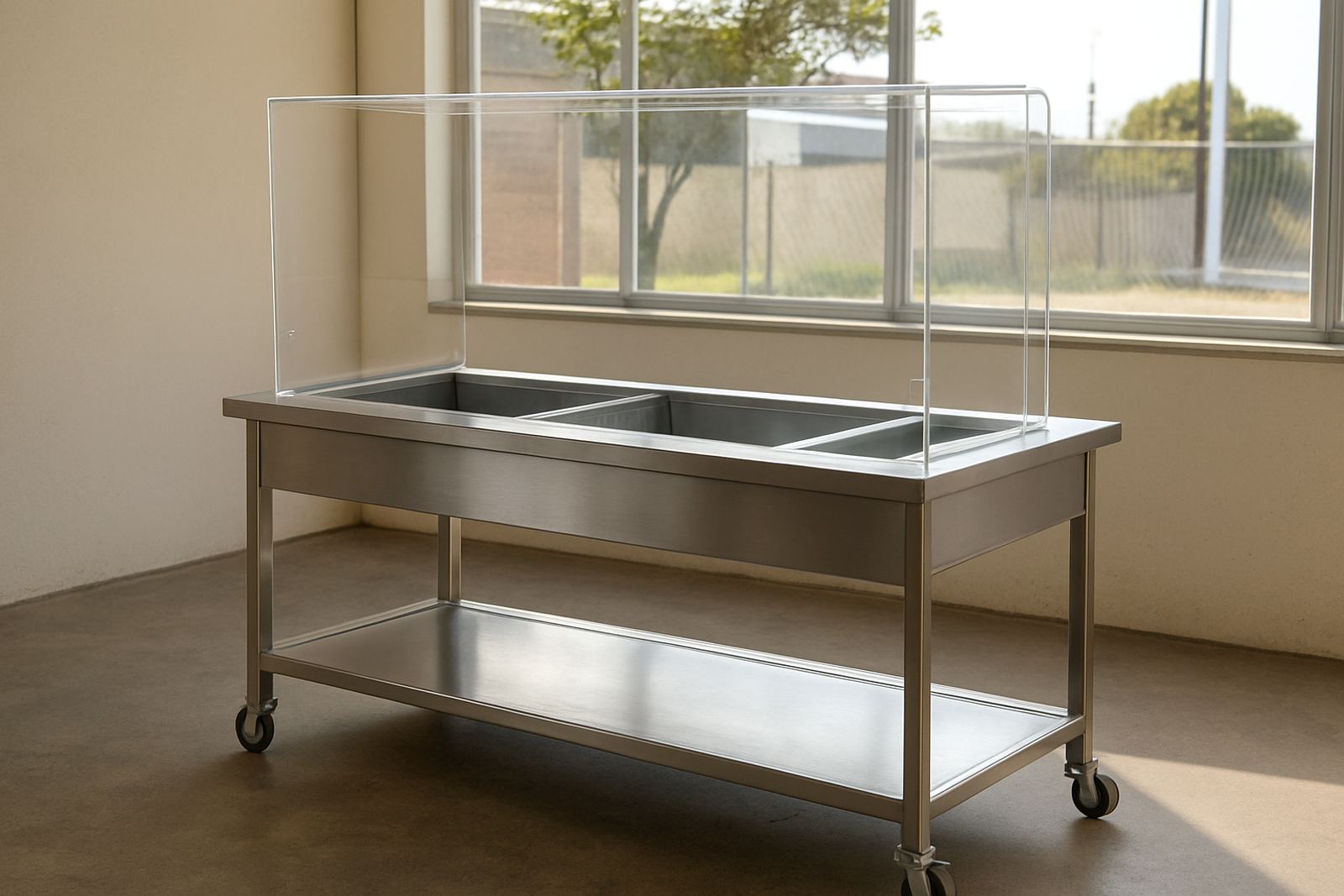
Most food guard jobs are straightforward on paper, but the details matter. We often cut panels for bakery counters, takeaway tills, deli service windows, school tuckshops, restaurant pick-up points, and factory canteen serving lines. Some setups need a full-height screen with a pass-through gap, while others only need a short sneeze guard over the serving edge.
Typical setups include flat panels with polished-looking edges, slot-mounted screens, and small return panels that wrap around the side of a counter. Where the guard must sit over a display or serving tray, we can cut to the exact width and height needed. If you are matching an existing frame, bring the measurements carefully because a few millimetres off can leave gaps or loose fittings.
- Counter-top sneeze guards
- Free-standing serving barriers
- Side returns for tills and payment points
- Custom panels for canteens, bakeries and deli lines
Planning the layout before you order
The best food guard layout starts with how the staff actually move. Think about where trays are handed over, where cash or card payments happen, and where people lean during a rush. A guard that is too high can make service awkward, while one that is too low may not give enough separation at a busy counter. We always suggest checking sight lines too, especially where staff must see the till screen or speak to customers clearly.
For fixed counters, measure the full span and allow for brackets, stand-offs or insertion points. If the counter has a lip, tiled splashback or uneven surface, note that before cutting. This is where custom sizing helps, because a screen that is cut square on paper may still need a notch, hole mark or strip cut to fit properly. In some cases, a simple template saves time and avoids a second trip back to site.
- Measure the opening width, height and depth twice
- Allow space for brackets, fasteners and cleaning access
- Check for taps, rails, menu boards or shelf edges
- Plan for where trays, plates and hands will pass through
Thickness, edge finish and the right fittings
Food guards do not need the same spec everywhere. A light internal screen in a quiet coffee point may use a thinner sheet, while a busy serving counter or school line often needs something thicker for better rigidity. We can advise on sheet size, panel shape and whether the job needs straight cuts only or a more detailed cut with holes and edge finishing. If the guard is being handled often, a clean deburred edge helps reduce sharp points and makes the panel easier to fit.
Many customers also ask about film left on during installation. That is useful where the sheet is being drilled, positioned and adjusted on site, because it helps keep the surface cleaner during handling. Once the guard is fixed, the film can be removed and the surface wiped down. For jobs with repeating panels, labelling each piece saves time, especially on larger installations with several service bays.
- Straight cuts for simple screens
- Hole marking for brackets and stand-offs
- Edge deburring for a cleaner finish
- Film left on for safer handling during fitment
Typical budget ranges for food guards in Rand
Budget depends on size, thickness, cut complexity and how many panels you need. Small counter screens for a single till point are usually far more affordable than long serving-line barriers with multiple cut-outs. If you are comparing quotes, make sure the price includes the cutting method, any hole marking, and whether the panels are packed for courier or prepared for collection in Epping or another nearby area.
As a rough working guide, small food guard panels can start from around R450 to R900 each for simple cut-to-size pieces. Mid-sized screens for cafes, bakeries or schools often fall between R900 and R2 500 per panel depending on dimensions and finish. Larger project runs, or jobs needing panel cutting, strip cutting and batch labelling, can run from about R3 000 upwards for the full set. Couriers are usually quoted separately for national delivery and packing needs to be secure because long sheets can be damaged if they move in transit.
For operators in Cape Town, Paarl, Stellenbosch or Somerset West, collection can reduce cost if the job is ready on time. For customers farther afield, we can courier the finished sheets nationwide so the fitment team has what they need on arrival.
Mistakes that cause problems after installation
The most common mistakes are simple ones. People sometimes order a panel that is too short, forget the return section at the side, or allow no room for fixing hardware. Another issue is choosing the wrong opening size for a serving area, which can make service slower and awkward during busy lunch periods. On food guards, small errors turn into daily annoyances very quickly.
It also helps to avoid over-complicated layouts. If a counter only needs a basic barrier, adding unnecessary joints or too many small pieces can make cleaning harder. On the other hand, trying to force one large sheet into a cornered space can lead to stress marks or poor support. Our advice is to keep the design practical, use the minimum number of joins, and make sure the finished guard can be wiped down properly at closing time. That saves time for staff and keeps the area looking neat.
- Do not guess the height or opening size
- Do not forget fixing points and support spacing
- Do not make the service gap too small for trays or plates
- Do not choose a layout that is hard to clean every day
How to order cut food guard panels from Epping
If you already have measurements, send them with a short note on where the panels will be used, how they will be fitted and whether you need straight cuts, hole marking or strip cutting. If the job is for a food counter, deli line or serving window, mention the opening size and whether the sheet should be finished for collection or couriered to your site. That helps us recommend the most practical cut and avoid waste.
Clients usually reach us through the enquiry form on our contact page, and our team will guide the order from there. Morne van Rensburg oversees the business, with support from Ayanda Mkhize on sales, Jared Petersen in production, Zanele Ndlovu on customer support, Ruan Botha on cutting, and Tumi Molefe on logistics. For food guards, this means the measurements are checked, the panels are labelled if needed, and the finished pieces are packed carefully for collection or nationwide delivery.