Prototype enclosure brief from Montague Gardens
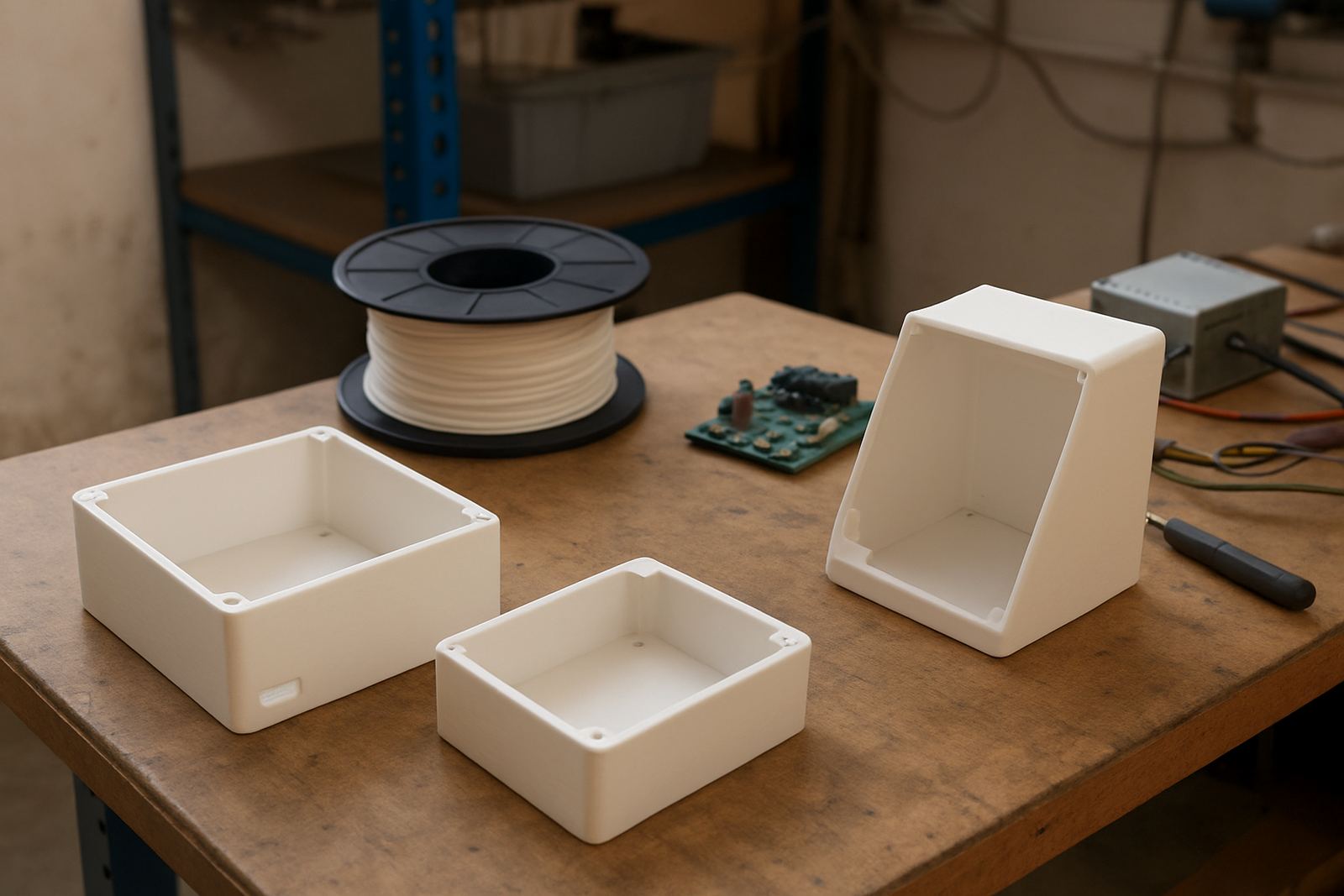
The client was a small electronics and product development team working from Montague Gardens, Cape Town. They needed prototype enclosures for a new control unit, with enough stiffness for bench testing and a clean surface for presentations. The parts had to be printed quickly, checked against circuit boards and repeaters, then adjusted before the next round.
The main requirement was a material that could handle repeated handling without becoming brittle. The housings also needed to cope with normal workshop conditions, including warm summer days and power interruptions that can stretch print times. White was preferred because it made the panel lines, clip points and screw positions easier to see during fit checks.
- Application: prototype electronic enclosures
- Location: Montague Gardens, Cape Town
- Material: white PETG filament
- Use case: fit checks, assembly trials and short-run prints
Why PETG was the right call for this job
PETG suits enclosure work because it offers a good balance of toughness and printability. It is more forgiving than many brittle materials when a lid is removed a few times, and it keeps its shape well enough for brackets, mounts and clip features. For this project, the team wanted parts that could be handled by technicians and not crumble at the first adjustment.
We supplied filament suited to standard FDM printers, with consistent diameter for steady feeding and fewer pauses during longer prints. That matters when a batch is running overnight or over a load-shedding window, because a clean feed helps reduce failed parts. The client also wanted a material that could be sanded lightly and drilled for final tweaks, which PETG handled without drama.
- Good impact resistance for workshop use
- Suitable for lids, clips and internal mounts
- Works well for test iterations before final tooling
- Can be finished with light sanding and post-drilling
Specs we used for the prototype run
The order was set up as a short prototype run rather than a full production batch. We supplied white PETG filament in a standard 1.75 mm format, packed for local printing work and labelled by job so the team could separate test versions from final-fit parts. The enclosure pieces ranged from small board covers to larger control shells, with wall thicknesses adjusted during the first print cycle.
For the fit checks, the client worked with 2 mm to 3 mm walls in the key housing sections, with allowance for screw bosses, standoffs and cable exits. We also advised on orienting the prints to keep layer lines away from the main clip points. That cut down on reprints and made the first round of housings more useful for real assembly testing.
- Filament size: 1.75 mm
- Colour: white
- Print use: prototype housings and fit checks
- Typical wall range used: 2 mm to 3 mm
- Features included: screw bosses, standoffs, cable openings
What we supplied and how we handled it
We prepared the filament for courier delivery to the client in Montague Gardens and included clear job labelling so their team could track which reel matched which print stage. Because the parts were for fit testing, the client asked for more than one short batch. That let them print a first pass, check hole positions and clip tension, then move straight into a corrected run without waiting for another material delivery.
In jobs like this, practical handling counts. We packed the reels to protect them from dust and damp during transport, especially since Cape Town weather can move from dry to humid in a short space of time. The team also needed quick advice on print settings and support use, so we kept the notes simple and direct: stable bed adhesion, moderate cooling and careful layer height selection for the enclosure lids.
- Courier packing and job labelling included
- Short batch supply for multiple test prints
- Advice on support placement and print orientation
- Material kept clean for workshop use on arrival
Timeline from first order to fit approval
The work moved over three weeks. In week one we confirmed the enclosure dimensions, the number of test pieces and the board clearances. In week two the first printed housings were checked against the internal hardware, and small changes were made to the standoffs and screw positions. By week three the revised parts were accepted for a more formal fit review with the client’s own team.
This sort of timeline is common for electronic enclosure work because one dimension that is off by even a small amount can affect lid closure or port access. The advantage of using PETG for the tests was that the team could react quickly and print again without changing material type. That kept the project moving, even with a few interruptions caused by site work and rotating shifts, which is just how many small manufacturing teams operate in Cape Town.
Results from the enclosure test run
The finished prototypes gave the client a clear view of how the final enclosure would sit on the board, how the cable routes would behave and whether the fasteners were in the right place. The white finish made inspection easier, especially for checking print quality around corners, vents and cut-outs. Most importantly, the team could handle the parts repeatedly without cracking the shells or loosening the clip features.
The client ended up with a cleaner path to final approval and fewer back-and-forth adjustments. The material held up well for repeated assembly, and the job labels helped the team separate approved parts from earlier versions. For a small enclosure project, that makes a real difference because it keeps the workshop tidy and avoids mixing up a near-final print with an older test piece.
- Better visual inspection of fit points and cut-outs
- Stable enclosure shape through repeat handling
- Fewer reprints after the first revision round
- Easier internal review before final production
What we would do again for a similar project
For another Montague Gardens enclosure project, we would follow the same approach: confirm the board dimensions early, supply labelled filament in a short batch and keep the first print focused on fit rather than finish. That gives the client useful data fast, which is often more valuable than chasing a perfect surface on the first try. If the enclosure has vents, LED windows or cable glands, we would also set aside a second version for tolerance checks.
We would keep recommending PETG for prototype housings where the team needs a practical material that prints cleanly and stands up to normal handling. It is a good fit for manufacturing, design studios and technical teams working in compact spaces where every part has to earn its place. In this kind of work, a few millimetres can decide whether a lid closes properly or not, so the material choice matters more than people sometimes expect.
Key facts
| Project | Prototype electronic enclosures |
|---|---|
| Town | Montague Gardens, Cape Town |
| Material | White PETG filament |
| Filament size | 1.75 mm |
| Timeline | 3 weeks |
| Scope | Fit checks, short-run test prints, courier delivery |